Nava Thakuria
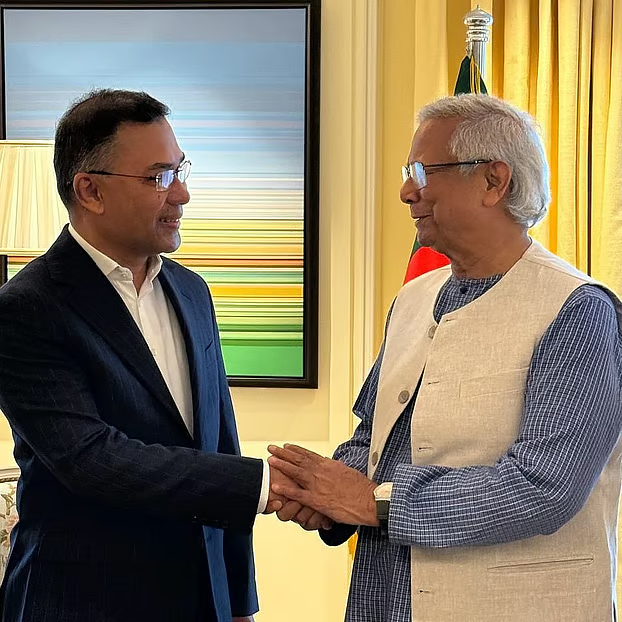
As Bangladesh heads for 13th Parliamentary election and the referendum on July National Charter simultaneously on Thursday (12 February 2026), the interim government chief Professor Muhammad Yunus urged all participating candidates to rise above personal and party interests to prioritize greater interest of the Muslim majority nation regardless of the poll-outcomes. Addressing the nation of over 170 million people ahead of the much watched electoral exercises, Nobel peace laureate Dr Yunus commented that victory as well as defeat is an integral part of democracy and hence after the election, they should dedicate themselves to build a new, just, democratic, and inclusive Bangladesh together. Chief adviser of the caretaker government also asked all voters to participate in the process enthusiastically in a festive spirit. Prof Yunus made a special appeal to the women and young voters, many of whom were deprived of the opportunity to exercise their franchise in earlier occasions, to come forward showing their commitment for a new beginning.
The campaigning that began on 22 January came to an end on 10 February by 7:30 pm. The electoral authorities have imposed a ban on all public rallies and processions for 96 hours before and after voting day. The polling on Thursday will begin at 7:30 am to continue till 4:30 pm. Nearly 400 foreign election observers including around 200 journalists representing 45 global media outlets arrived in the south Asian nation. On 12th parliamentary elections (held on 7 January 2024), there were only 158 global observers comprising a few foreign media persons. Meanwhile, a two-day government-announced general holiday began on 11 February, whereas Friday and Saturday (13, 14 February) are weekly holidays in Bangladesh.
Notably, ousted Prime Minister Sheikh Hasina's party Awami League is barred from participation in the electoral process leaving a fair space to the arch rival Bangladesh Nationalist Party (BNP) in the election. The country had the last general election in January 2024, but the overthrowing of Hasina's government following a student-led mass uprising just after six months necessitated the polls. The interim government in Dhaka had invited many countries including India, Nepal, Australia, Brazil, Canada, Egypt, France, Kuwait, Morocco, Nigeria, Romania, etc to send election observers. Global bodies like the European Union, Commonwealth Secretariat, SAARC Human Rights Foundation, Asian Network for Free Elections, Organisation of Islamic Cooperation, SNAS Africa, Polish Institute of International Affairs, US-based International Republican Institute and National Democratic Institute, etc agreed to send their election observers.
Meanwhile, the New York-based press watchdog Committee to Protect Journalists (CPJ) has urged all major Bangladesh political parties to protect press freedom in the troublesome country. The CPJ in a statement called for urgent steps to safeguard press freedom and journalists' safety on the eve of national election. Sending separate letters to the office bearers of Bangladesh Nationalist Party (BNP), Jamaat-e-Islami Bangladesh, student-led National Citizen Party and Jatiya Party, the global body urged them 'to make public commitments to protect journalists during the election period' by rejecting violence, intimidation and also misuse of criminal or national-security laws. Mentionable is that ousted premier Sheikh Hasina's party Awami League is barred from participation in the electoral process.
The CPJ statement argued that the risks to journalists intensified in the pre-election period across Bangladesh with continuing imprisonment of scribes on unverified charges and also longstanding impunity for violence against media professionals that contributed to a climate of fear and self-censorship. Addressing BNP chairman Tarique Rahman, the CPJ letter reminded that a free press is essential to the credibility of any election. Journalists play a critical role in informing voters, scrutinizing those in power, and enabling meaningful public debate. The BNP can demonstrate national leadership and strengthen public trust in the electoral process by committing to this foundational democratic value. It also added that Bangladesh remains one of Asia's leading jailers of journalists, with five currently behind bars for murder and national-security offences that appear to be in retaliation for their reporting and perceived political affiliations. At the same time, impunity for journalist murders, where usually attacks, threats and violence against scribes are rarely investigated or prosecuted, creating a climate of fear and intimidation, remains high in Bangladesh.
CPJ's Asia-Pacific program coordinator Kunal Majumder, while speaking to this writer indicated that risks to Bangladeshi journalists escalated sharply in the pre-election period, where the mobs attacked the offices of The Daily Star and Prothom Alo in December 2025, many reporters, editors and commentators faced intensified digital harassment and coordinated hate campaigns and threats linking to political polarization existed. "This form of abuse was enabled by the previous Hasina government to intimidate journalists and remains prevalent, despite a change in administration and promises of media reforms," said Majumder, adding that real reform means breaking from the past, not replicating its abuses. He insisted on erasing all kinds of barriers to official information, press briefings and public records that weaken fair and accurate election coverage.
Earlier, the Geneva-based media safety & rights body Press Emblem Campaign (PEC) condemned the murder of Bengali Hindu journalist Rana Pratap Bairagi (45) in Jessore locality on 5 January and demanded a thorough probe to book the culprits and punish them under the law. Moreover, at least 12 Bangladeshi journalists sustained injuries in an attack by extortionists in Narsingdi on 26 January. Denouncing the incident, PEC chairman Blaise Lempen urged Dhaka to bring the group of extortionists to justice. Bangladesh Editors' Council also called on the authorities to ensure the safety and security of journalists during the election period. The council in a statement argued that the working journalists while gathering information during elections often face various threats and hence the interim government, election commission and other responsible law enforcement agencies should take effective measures to guarantee adequate security for the media professionals.
Meanwhile, the western media outlets pour views that the BNP led alliance is the front runner in the coming election and chairman Rahman is projected as the new premier of Bangladesh. When Rahman returned to his home country on 25 December ending a self-imposed exile in the United Kingdom for 17 years, he was greeted by millions of people. The son of former Bangladesh President Ziaur Rahman and former premier Khaleda Zia responded to the public with a visionary line 'I have a plan' imitating the historic speech (I Have a Dream) of Martin Luther King Jr in 1963. Bangladesh's first female head of the government Begum Zia died on 30 December at the age of 80, following which he received pouring condolences from sympathizers amid the government declaring three days of state mourning.
The US-based news magazine The Diplomat recently carried an analytical piece predicting the electoral progress for Rahman to become Bangladesh's next premier. Similarly, Time magazine and Bloomberg media agency, referring to several opinion polls, projected him as the front-runner ahead of the election. Earlier, the UK-based weekly The Economist also anticipated the 60-year-old scion of a famous political family to emerge as head of the government in Dhaka. In various election rallies, Rahman promised to prioritize job creation, technical education, information technology, sports, etc. The soft spoken politician also emphasized on creating a new Bangladesh with mutual trust, respect and benefits to everyone living in a peaceful state under the rule of law and freedom of speech.