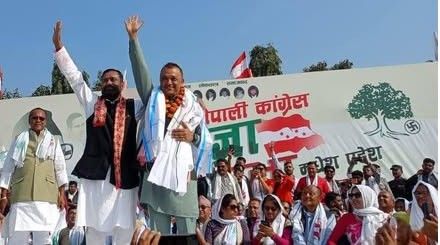
Kathmandu, Janakpur Dham, February 18, 2026: In a move that observers are calling a watershed moment for Nepal’s oldest political party, Nepali Congress (NC) President Gagan Kumar Thapa delivered a high-stakes address in Janakpur today, February 18, 2026. Speaking under the banner of the "Janakpur Declaration," Thapa sought to bridge the trust gap between the political establishment and a restless electorate, framing the upcoming March 5 parliamentary elections as a "new start" for both the party and the nation. The speech, delivered at a massive assembly, was marked by a rare and candid apology to the youth who led the "Gen Z rebellion" of late 2025, with Thapa promising that the Nepali Congress is now operating under "new management" that values merit over nepotism.
The centerpiece of the declaration is a 10-point "Contract with the People," a strategic rebranding of the party’s election manifesto designed to emphasize accountability. Thapa outlined a bold economic roadmap, headlined by a framework to create 500,000 local jobs annually to stem the tide of youth migration to the Gulf and Malaysia. He further committed to a "clean hands" policy, pledging to investigate illegal assets and decouple politics from business interests. On the social front, Thapa positioned healthcare and education as fundamental rights, promising a universal insurance model that prevents families from falling into debt due to medical emergencies, alongside a digital-age overhaul of the national curriculum.
Shifting the political geography of the race, Thapa used the Janakpur stage to explain his high-risk decision to contest the election from Sarlahi-4 rather than his traditional Kathmandu constituency. In a direct critique of "centralized" politics, he argued that the Madhesh has historically been treated as a mere "vote bank" by Kathmandu-based leaders. By tying his personal political survival to the prosperity of the plains, Thapa signaled a desire to integrate the Madhesh into the core of national power. "If Janakpur does not prosper, Nepal does not prosper," he told the crowd, emphasizing that the prosperity of the Terai is the primary engine for the country’s overall growth.
Finally, Thapa addressed the growing competition from newer political entities, arguing that while fresh voices are necessary, the country’s stability depends on a reformed and experienced establishment. He contended that the Nepali Congress has undergone a genuine internal transformation, shifting from a culture of entitlement to one of service delivery. As the party prepares to release its full technical manifesto in Kathmandu tomorrow, Thapa’s Janakpur Declaration stands as an ambitious attempt to reclaim the political center and prove that a legacy party can indeed be the vehicle for radical change.